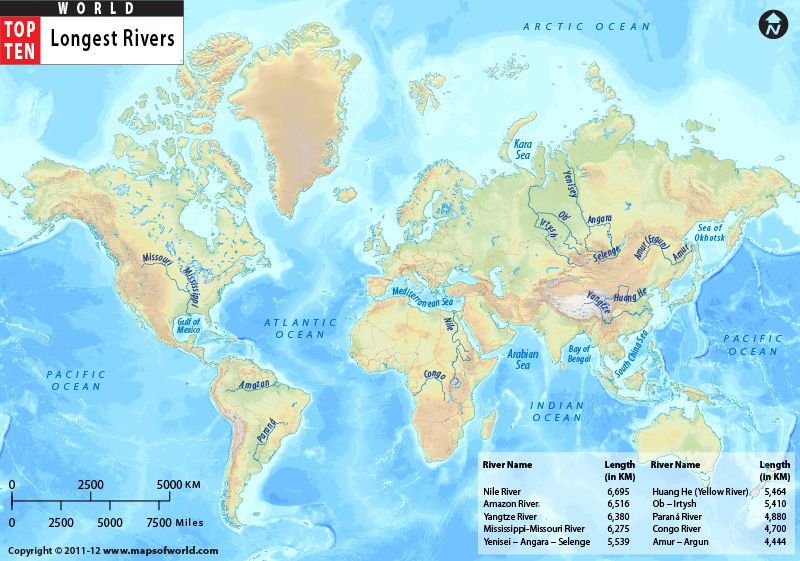
Discover The World's Longest Rivers: Unveiling Nature's Majestic Waterways
One of the 10 longest rivers in the world is a descriptor used to identify a river that ranks among the ten longest rivers globally. These rivers are renowned for their impressive length, which often spans multiple countries and ecosystems.
The identification of the ten longest rivers holds significant importance as it highlights the magnitude and grandeur of these natural wonders. These rivers play a crucial role in shaping the geographical landscapes they traverse, providing water resources for various human activities, and supporting diverse ecosystems. Historically, major civilizations have flourished along the banks of these rivers, recognizing their importance for transportation, trade, and agriculture.
In the following sections, we will delve into the specific characteristics, ecological significance, and human interactions associated with each of these ten longest rivers, exploring their unique contributions to the global environment and human history.
One of the 10 Longest Rivers in the World
The world's ten longest rivers are colossal natural wonders, shaping landscapes, sustaining ecosystems, and nurturing civilizations for millennia. Here are ten key aspects that capture their essence:
- Length: Spanning thousands of kilometers, these rivers traverse vast distances.
- Volume: Carrying immense volumes of water, they influence global water cycles.
- Drainage basins: Encompassing vast areas, their basins support diverse ecosystems.
- Economic importance: Providing water for irrigation, transportation, and hydropower.
- Cultural significance: Inspiring art, folklore, and shaping human history.
- Biodiversity hotspots: Supporting a wealth of plant and animal species.
- Environmental challenges: Facing threats from pollution, climate change, and over-exploitation.
- Conservation efforts: Protecting these rivers is crucial for preserving ecosystems and human well-being.
- Exploration and adventure: Offering opportunities for scientific research and thrilling expeditions.
- Global connectivity: Linking countries and continents, they facilitate trade and cultural exchange.
These aspects highlight the multifaceted importance of the world's longest rivers. From their sheer size and ecological significance to their cultural and economic value, these rivers are not mere geographical features but lifelines that sustain our planet and enrich human civilization.
Length
The extraordinary length of these rivers is a defining characteristic that sets them apart from others. Spanning thousands of kilometers, they traverse vast distances, often crossing multiple countries and ecosystems. This exceptional length has significant implications for their ecological functioning, economic importance, and cultural significance.
- Ecological Significance: The length of these rivers creates diverse habitats and microclimates along their courses. This diversity supports a wide range of plant and animal species, making them biodiversity hotspots.
- Economic Importance: The length of these rivers makes them vital for transportation and trade. They provide navigable waterways for commercial shipping, connecting inland areas to coastal ports and facilitating global commerce.
- Cultural Significance: The length of these rivers has shaped human history and culture. They have served as natural boundaries, influenced settlement patterns, and inspired art, literature, and folklore.
In conclusion, the length of these rivers is not merely a physical attribute but a fundamental aspect that contributes to their ecological richness, economic importance, and cultural significance. These rivers are not just geographical features but lifelines that have shaped civilizations and continue to play a vital role in our world today.
Volume
The immense volume of water carried by the world's longest rivers has a profound impact on global water cycles. These rivers are major arteries in the Earth's hydrological system, transporting vast quantities of water from their source regions to the oceans.
- Water storage and release: The longest rivers act as natural reservoirs, storing and releasing water over time. During periods of heavy rainfall or snowmelt, they can accommodate excess runoff, preventing flooding and regulating the flow of water downstream.
- Nutrient transport: The water carried by these rivers transports essential nutrients, sediments, and organic matter across vast distances. This process supports aquatic ecosystems and fertilizes floodplains, making them highly productive agricultural areas.
- Climate regulation: The evaporation and transpiration from these rivers contribute to regional and global climate patterns. They release moisture into the atmosphere, influencing cloud formation and precipitation.
- Global water balance: The longest rivers play a crucial role in maintaining the global water balance. They transport freshwater from land to oceans, ensuring a continuous exchange of water between different parts of the world.
In conclusion, the volume of water carried by the world's longest rivers is not just a physical characteristic but a vital factor in shaping global water cycles, supporting ecosystems, and influencing climate patterns. These rivers are essential components of the Earth's hydrological system, and their conservation is crucial for the health of our planet and the well-being of human societies.
Drainage basins
The drainage basins of the world's longest rivers are vast and encompass a wide range of ecosystems, contributing to the ecological richness of these river systems.
- Size and Scope: The drainage basins of these rivers cover extensive areas, spanning multiple countries and climatic zones. This vastness allows for the development of diverse habitats, from headwaters in mountainous regions to deltas and estuaries where the rivers meet the ocean.
- Ecosystem Diversity: The varied topography and climate within these drainage basins support a wide range of ecosystems, including forests, grasslands, wetlands, and aquatic environments. Each ecosystem provides unique habitats for a multitude of plant and animal species.
- Nutrient Cycling: The rivers and their associated ecosystems play a vital role in nutrient cycling. Nutrients are transported downstream, enriching floodplains and supporting the growth of vegetation. These nutrients eventually reach the oceans, contributing to marine ecosystems.
- Biodiversity Hotspots: Many of the longest rivers flow through regions that are recognized as biodiversity hotspots. These areas are home to a large number of endemic and threatened species, making the conservation of these river basins crucial for preserving global biodiversity.
In conclusion, the drainage basins of the world's longest rivers are not just geographical features but complex and dynamic ecosystems that support a vast array of life. Their conservation is essential for maintaining the ecological integrity of these river systems and preserving the rich biodiversity that they harbor.
Economic importance
The economic importance of the world's longest rivers stems from the vast array of resources and services they provide. These rivers are vital for irrigation, transportation, and hydropower generation, contributing significantly to economic development and human well-being.
- Irrigation: The longest rivers provide a reliable source of water for irrigation, enabling the cultivation of crops in arid and semi-arid regions. This water is essential for food production, supporting local communities and global food security.
- Transportation: The longest rivers have served as important transportation routes for centuries, facilitating trade and commerce. They provide navigable waterways for ships and barges, connecting inland areas to coastal ports and enabling the transportation of goods over long distances.
- Hydropower: The immense volume and flow of the longest rivers make them ideal for hydropower generation. Dams and hydroelectric power plants harness the energy of these rivers to produce renewable electricity, providing a clean and sustainable source of power.
The economic importance of the world's longest rivers is undeniable. They provide essential resources and services that support livelihoods, drive economic growth, and contribute to the overall well-being of human societies. Sustainable management and conservation of these rivers are crucial to ensure their continued economic benefits for present and future generations.
Cultural significance
The world's longest rivers have played a profound role in shaping human culture and history. Their enduring presence and grandeur have inspired countless works of art, folklore, and literature, while also influencing the course of human civilization.
One of the most significant ways in which these rivers have influenced culture is through their role as natural boundaries and meeting points. They have shaped settlement patterns, influenced political and economic development, and served as crossroads for cultural exchange.
For example, the Nile River has been central to the development of ancient Egyptian civilization, providing water for irrigation and transportation, and serving as a source of spiritual and cultural inspiration. Similarly, the Yangtze River has played a pivotal role in Chinese history, supporting the development of major cities and serving as a vital artery for trade and commerce.
Beyond their practical importance, the world's longest rivers have also captured the human imagination. They have been the subject of countless works of art, from paintings and sculptures to music and literature. Their beauty, power, and mystery have inspired awe and wonder in people throughout history.
In conclusion, the cultural significance of the world's longest rivers is undeniable. They have shaped human history, inspired art and folklore, and continue to hold a special place in the human psyche. Understanding this cultural significance is essential for appreciating the full value of these rivers and for ensuring their conservation for future generations.
Biodiversity hotspots
The world's longest rivers often flow through regions that are recognized as biodiversity hotspots. These areas are home to a large number of endemic and threatened species, making the conservation of these river basins crucial for preserving global biodiversity.
There are several reasons why the longest rivers are often associated with biodiversity hotspots. First, these rivers provide a diverse range of habitats, from headwaters in mountainous regions to deltas and estuaries where the rivers meet the ocean. This diversity of habitats supports a wide range of plant and animal species.
Second, the longest rivers often flow through regions with a long history of human habitation. This has led to the development of complex and diverse ecosystems that have adapted to the presence of humans. These ecosystems often support a high number of endemic species that are found nowhere else on Earth.
Third, the longest rivers often provide important migration routes for animals. For example, the Nile River is a vital migration route for birds, while the Yangtze River is a migration route for fish. These migration routes are essential for the survival of many species.
The conservation of the world's longest rivers is therefore essential for preserving global biodiversity. These rivers provide important habitats for a wide range of plant and animal species, including many that are endemic and threatened. By protecting these rivers, we can help to ensure the survival of these species and the ecosystems that they depend on.
Environmental challenges
The world's longest rivers are facing a multitude of environmental challenges, including pollution, climate change, and over-exploitation. These challenges threaten the health of these rivers and the ecosystems they support.
- Pollution: The world's longest rivers are often heavily polluted with industrial waste, agricultural runoff, and sewage. This pollution can harm aquatic life, contaminate drinking water sources, and damage ecosystems.
- Climate change: Climate change is altering the flow patterns of the world's longest rivers. This can lead to flooding, droughts, and other disruptions that can damage ecosystems and harm human populations.
- Over-exploitation: The world's longest rivers are often over-exploited for water resources, such as irrigation, hydropower, and drinking water. This can lead to depletion of water resources and damage to ecosystems.
The environmental challenges facing the world's longest rivers are a serious threat to these vital ecosystems. It is important to take action to address these challenges and protect these rivers for future generations.
Conservation efforts
The world's longest rivers are vital ecosystems that provide a wide range of benefits to humans and nature. They support diverse plant and animal life, provide water for drinking, irrigation, and transportation, and generate hydropower. However, these rivers are facing a multitude of threats, including pollution, climate change, and over-exploitation. Conservation efforts are essential to protect these rivers and the ecosystems they support.
One of the key reasons why conservation efforts are so important is that the world's longest rivers are home to a disproportionate number of the world's plant and animal species. For example, the Amazon River basin is home to an estimated 10% of the world's known species. These species are adapted to the unique conditions of the riverine environment, and many of them are found nowhere else on Earth. If these rivers are not protected, these species could be lost forever.
In addition to their ecological importance, the world's longest rivers also play a vital role in human well-being. They provide water for drinking, irrigation, and transportation for millions of people around the world. They also generate hydropower, which is a clean and renewable source of energy. If these rivers are not protected, these benefits could be lost, and millions of people could be affected.
There are a number of things that can be done to protect the world's longest rivers. These include reducing pollution, mitigating climate change, and managing water resources sustainably. By taking these steps, we can help to ensure that these vital ecosystems continue to provide benefits to humans and nature for generations to come.
Exploration and adventure
The world's longest rivers have long been a source of fascination and inspiration for explorers and adventurers. These rivers offer unique opportunities for scientific research and thrilling expeditions, providing valuable insights into the natural world and testing the limits of human endurance.
- Scientific Research: The world's longest rivers are home to a wealth of biodiversity, making them ideal for scientific research. Scientists study these rivers to learn about aquatic ecosystems, water quality, and the impact of human activities on the environment. For example, the Amazon River is home to the largest freshwater fish diversity in the world, making it a valuable site for studying fish ecology and evolution.
- Exploration and Discovery: The world's longest rivers offer opportunities for exploration and discovery. Explorers have long ventured into these rivers to map their courses, discover new species, and learn about the cultures of the people who live along their banks. For example, the Nile River has been explored by explorers since ancient times, and it continues to be a popular destination for modern-day explorers.
- Thrilling Expeditions: The world's longest rivers offer a variety of thrilling expeditions for adventurers. These expeditions can range from white-water rafting to kayaking to canoeing. For example, the Colorado River through the Grand Canyon is one of the most popular white-water rafting destinations in the world.
- Cultural Exchange: The world's longest rivers flow through a variety of cultures, offering opportunities for cultural exchange. Explorers and adventurers can learn about the different cultures of the people who live along the rivers, and they can share their own cultures with these people. For example, the Mekong River flows through six different countries, and it is home to a variety of different cultures.
The world's longest rivers offer a unique combination of scientific research, exploration and discovery, thrilling expeditions, and cultural exchange. These rivers are a valuable resource for scientists, explorers, adventurers, and anyone who is interested in the natural world.
Global connectivity
The world's longest rivers have played a vital role in global connectivity throughout history. By providing navigable waterways, these rivers have facilitated trade and cultural exchange between different regions and civilizations.
One of the most notable examples of this is the Nile River. The Nile has been a major trade route for centuries, connecting Egypt with the rest of Africa and the Middle East. The river has also played a significant role in the development of Egyptian culture, and its influence can be seen in the art, architecture, and literature of the region.
Another example is the Yangtze River in China. The Yangtze is the longest river in Asia, and it has been a major trade route for centuries. The river has also played a significant role in the development of Chinese culture, and its influence can be seen in the art, architecture, and literature of the region.
The global connectivity provided by the world's longest rivers has had a profound impact on human history. These rivers have facilitated the spread of ideas, goods, and people, and they have played a major role in the development of human civilization.
FAQs about the World's Longest Rivers
This section addresses common questions and misconceptions about the world's longest rivers, providing concise and informative answers.
Question 1: Which is the longest river in the world?
The Nile River in Africa is the longest river in the world, stretching approximately 6,650 kilometers (4,132 miles).
Question 2: How many rivers are longer than 6,000 kilometers?
Only two rivers in the world are longer than 6,000 kilometers: the Nile River and the Amazon River.
Question 3: Which river has the largest drainage basin?
The Amazon River has the largest drainage basin in the world, covering an area of approximately 7 million square kilometers (2.7 million square miles).
Question 4: Which river is the most polluted?
The Yangtze River in China is considered one of the most polluted rivers in the world due to industrial and agricultural runoff.
Question 5: Which river is the most important for transportation?
The Mississippi River in the United States is the most important river for transportation in the world, carrying a vast amount of agricultural and industrial goods.
Question 6: Which river is the most biodiverse?
The Amazon River is home to the greatest diversity of plant and animal species on Earth, making it one of the most biodiverse ecosystems in the world.
These FAQs provide a concise overview of various aspects related to the world's longest rivers. They aim to clarify common misconceptions and offer insights into the significance of these mighty waterways.
For further exploration, the following section delves into the environmental challenges facing the world's longest rivers and highlights the importance of conservation efforts to preserve these vital ecosystems.
Tips for Conserving the World's Longest Rivers
The world's longest rivers provide invaluable ecological, social, and economic benefits. Preserving these majestic waterways requires a concerted effort to address environmental challenges and promote sustainable practices.
Tip 1: Reduce Pollution: Industries and municipalities should implement effective wastewater treatment systems to minimize the discharge of harmful pollutants into rivers. Agricultural practices should prioritize sustainable techniques to reduce fertilizer and pesticide runoff.
Tip 2: Mitigate Climate Change: Global efforts to reduce greenhouse gas emissions will help stabilize river flow patterns, prevent extreme weather events, and protect riparian ecosystems.
Tip 3: Manage Water Resources Sustainably: Water use should be optimized through efficient irrigation techniques, conservation measures, and responsible dam operations. Collaborative water management plans are essential to balance the needs of human populations and ecosystems.
Tip 4: Protect Riparian Ecosystems: Riparian zones along riverbanks provide vital habitat and ecological services. Restoring and protecting these areas enhances water quality, reduces erosion, and supports biodiversity.
Tip 5: Promote Sustainable Tourism: Eco-friendly tourism practices minimize environmental impacts while supporting local communities. Controlled access, responsible waste management, and education programs ensure that river ecosystems are preserved for future generations.
Tip 6: Raise Awareness and Education: Public awareness campaigns and educational programs can foster a greater understanding of the importance of river conservation. Engaging local communities, schools, and organizations empowers individuals to take action.
By embracing these tips, we can collectively contribute to the preservation of the world's longest rivers. These invaluable ecosystems will continue to provide sustenance, inspiration, and economic prosperity for generations to come.
Conclusion
The world's longest rivers are majestic natural wonders that shape landscapes, sustain ecosystems, and nurture civilizations. They are not just geographical features but lifelines that have played a vital role in human history and continue to support our well-being.
This exploration of "one of the 10 longest rivers in the world" has highlighted the multifaceted importance of these rivers, from their ecological grandeur to their economic significance and cultural heritage. It has also emphasized the environmental challenges they face and the urgent need for conservation efforts to preserve these vital ecosystems.
As we move forward, it is imperative that we recognize the immense value of the world's longest rivers and take collective action to protect them. By implementing sustainable practices, promoting responsible water management, and fostering public awareness, we can ensure that these majestic waterways continue to thrive for generations to come.
Unveiling The Secrets: Die Hard Christmas Quotes Explored
Unveiling The Growing Presence Of Nigerians In The US: Surprising Insights Revealed
Unveiling The Hidden Wealth Of Danielle From American Pickers